
Twelve engineering services, one delivery standard
Each service below states the business problem it addresses, how KOP BUILD approaches it, what is typically delivered and the practical value the work is intended to produce.
- 01Custom Software Development
- 02Web Application Development
- 03Mobile Application Development
- 04Cloud Solutions
- 05DevOps and Infrastructure
- 06UI/UX and Product Design
- 07API and Systems Integration
- 08Software Modernisation
- 09Quality Assurance
- 10Cybersecurity Consulting
- 11Technical Discovery and Architecture
- 12Ongoing Software Support
Service 01
Custom Software Development
Business problem
Off-the-shelf products rarely match a process that gives a company its advantage, so teams end up bending the business around the tool or maintaining spreadsheets beside it.
Approach
We model the domain with the people who run it, define clear service and data boundaries, then build incrementally with automated verification from the first cycle.
Typical deliverables
- Domain and data model with documented boundaries
- Production application with automated build and deploy pipeline
- Test suite covering business rules and critical paths
- Operational documentation and handover walkthrough
Practical value
A system that fits the actual process, removes manual workarounds and can be extended without a rewrite.

Service 02
Web Application Development
Business-critical web platforms often grow into slow, fragile interfaces where a small change carries unpredictable risk.
Approach
A clear front-end architecture with a shared component library, a deliberate rendering strategy for performance, and typed contracts against the backend API.
Typical deliverables
- Component library and design tokens shared with designers
- Server-rendered or hybrid application tuned for Core Web Vitals
- Accessibility conformance checks in the delivery pipeline
- Documented API contracts and error handling behaviour
Practical value
Fast, accessible web software where new features can be added confidently by any engineer on the team.
Service 03
Mobile Application Development
Mobile users work with intermittent connectivity and limited screen space, and a poor release process makes every fix slow to reach them.
Approach
We design offline behaviour and synchronisation explicitly, secure local data storage, and automate build, signing and distribution from day one.
Typical deliverables
- Mobile application for the agreed platforms
- Offline and synchronisation strategy with conflict handling
- Automated build, signing and store release pipeline
- Crash reporting and usage instrumentation
Practical value
A mobile product that behaves predictably in real conditions and can be updated on a reliable schedule.

Service 04
Cloud Solutions
Business problem
Cloud adoption often reproduces old server habits, producing unpredictable bills, manual configuration and environments nobody can rebuild.
Approach
Architecture is designed for the cloud's actual properties: managed services where they fit, infrastructure as code, and cost attributed per workload.
Typical deliverables
- Target architecture with migration sequence and rollback points
- Infrastructure defined as code and stored in version control
- Environment parity across development, staging and production
- Cost and capacity reporting per workload
Practical value
Infrastructure that can be recreated from a repository, scaled to measured demand and explained line by line.

Service 05
DevOps and Infrastructure
Manual, undocumented release procedures make deployments rare, stressful and difficult to reverse when something goes wrong.
Approach
We automate the whole path from commit to production, add observability before it is needed, and make every deployment reversible by design.
Typical deliverables
- Continuous integration and delivery pipelines
- Monitoring, logging, tracing and alerting configuration
- Runbooks for deployment, rollback and incident response
- Backup, restore and failover procedures with test evidence
Practical value
Frequent low-risk releases, faster recovery from incidents and an operations story the client's team can run alone.
Service 06
UI/UX and Product Design
Interfaces built around database structure force users to learn the system instead of doing their work, which increases errors and training cost.
Approach
We map real tasks and their frequency, prototype the highest-risk screens early, and validate them with the people who will use the system daily.
Typical deliverables
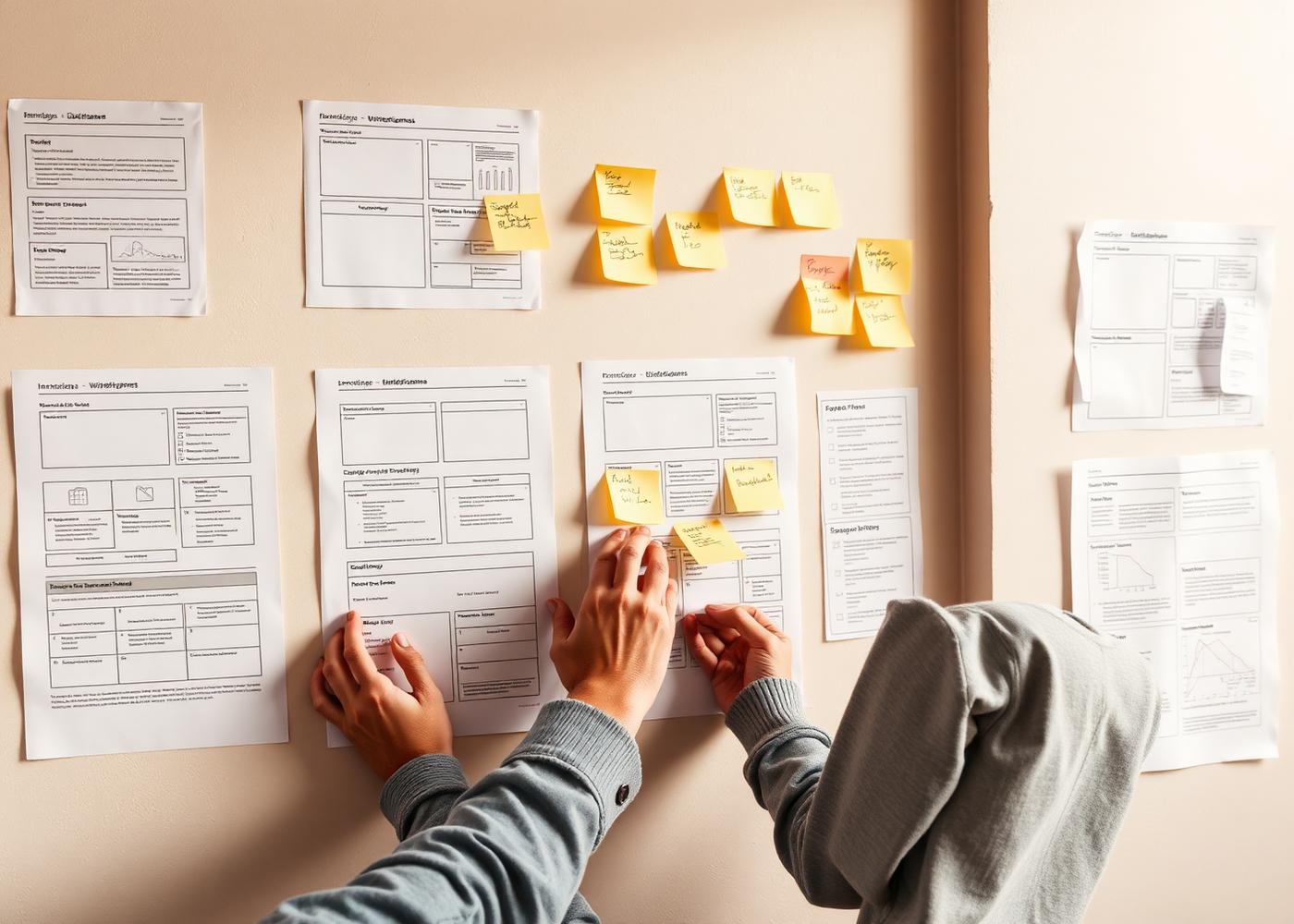
- Task flows and information architecture
- Interactive prototypes for critical journeys
- Design system with accessible component specifications
- Usability findings with prioritised changes
Practical value
Software people can use correctly under pressure, with measurably fewer mistakes and less onboarding effort.
Service 07
API and Systems Integration
Business problem
Separate business systems hold overlapping data, and people bridge the gap manually, creating delays and inconsistent records.
Approach
We define explicit data ownership and contracts, then implement integration with idempotent processing, retries and reconciliation instead of fragile point-to-point scripts.
Typical deliverables
- Integration architecture with documented data ownership
- Versioned API or event contracts and validation rules
- Error handling, retry and reconciliation mechanisms
- Monitoring of integration health and message flow
Practical value
Consistent data across systems, far less manual transfer and clear visibility when something needs attention.

Service 08
Software Modernisation
Legacy applications still run the business but resist change: unsupported dependencies, no tests and knowledge held by very few people.
Approach
Modernisation proceeds incrementally. We characterise current behaviour with tests, isolate the highest-change areas behind stable interfaces and replace them one at a time.
Typical deliverables
- Assessment of technical risk, dependencies and change hotspots
- Incremental modernisation roadmap with measurable milestones
- Extracted and re-implemented components with test coverage
- Documentation of the recovered domain knowledge
Practical value
The pace of change improves without a high-risk full rewrite, and operational risk drops at every step.
Service 09
Quality Assurance
When testing happens only at the end of a project, defects are found late, cost more to fix and erode trust in every release.
Approach
Quality is built into the pipeline: automated tests at the right levels, exploratory testing where judgement matters, and defect analysis that prevents repeats.
Typical deliverables
- Test strategy covering unit, integration and end-to-end levels
- Automated regression suite running on every change
- Performance and load test scenarios with baseline results
- Defect reporting and root-cause analysis process
Practical value
Fewer production defects, faster release cycles and a clear, evidence-based view of software readiness.

Service 10
Cybersecurity Consulting
Business problem
Security is often addressed after an audit or an incident, when remediation is expensive and disruptive to the roadmap.
Approach
We treat security as a functional requirement: threat modelling during design, hardened defaults, continuous scanning and least-privilege access throughout.
Typical deliverables
- Threat model and prioritised risk register
- Secure architecture and access control recommendations
- Dependency, container and infrastructure scanning in the pipeline
- Incident response and data breach notification procedures
Practical value
Reduced exposure, demonstrable due diligence and security work that fits the delivery schedule instead of interrupting it.

Service 11
Technical Discovery and Architecture
Large investments are approved on the basis of estimates made before anyone examined the constraints, and the plan breaks on contact with reality.
Approach
A short, focused discovery: current-state analysis, requirement framing, architecture options with trade-offs and a delivery plan sized against evidence.
Typical deliverables
- Current-state assessment and constraint analysis
- Architecture options with cost, risk and trade-off comparison
- Non-functional requirements, including security and availability targets
- Phased delivery plan with estimates and dependencies
Practical value
A decision that can be defended internally, with the largest unknowns resolved before major spending starts.
Service 12
Ongoing Software Support
After launch, systems drift: dependencies age, monitoring gaps appear and small issues accumulate until they become outages.
Approach
A defined support model with monitoring, agreed response expectations, scheduled maintenance and a visible backlog of incremental improvements.
Typical deliverables
- Monitoring and alerting coverage with escalation paths
- Regular dependency and platform upgrade cycles
- Incident handling with post-incident reviews
- Prioritised improvement and performance backlog
Practical value
Stable operation, controlled maintenance cost and a system that keeps improving instead of quietly decaying.
Service enquiries are handled by email
Service scope, engagement model and delivery sequence are agreed in writing before work begins. Enquiry details below are shown as plain text.
- Company
- KOP BUILD
- [email protected]
- Website
- kopbuild.com